
Common Porsche Repairs
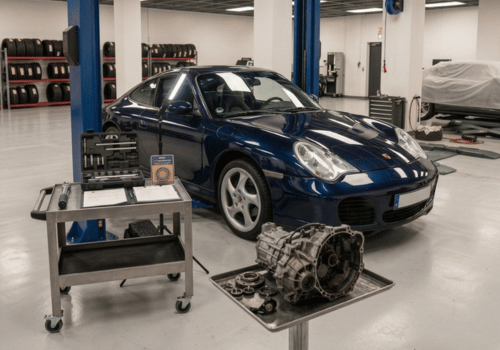
Common Porsche Repairs: IMS Bearings, Rear Main Seals, Coolant Leaks and PDK
Every Porsche model has a handful of known weak spots. Knowing which ones apply to your car, and catching them early, saves owners a great deal of money. This guide explains the Porsche repairs we see most often at Autos of Europe in Manchester: what causes them, which models are affected, the warning signs and what the repair involves.
If you're dealing with any of these, our Porsche technicians can inspect your car, confirm the problem with factory-level diagnostics and give you an honest recommendation, including when a problem can safely wait. Many of these issues are preventable with the right service plan, so pair this guide with our Porsche maintenance schedule. For everything else we do, visit our main Porsche repair and service page.
We'll always tell you the difference between a problem that needs attention now and one you can plan for. On an older Porsche, a good inspection often turns up a few small items, and knowing which matter most lets you spend your money where it counts.
IMS Bearing (Intermediate Shaft Bearing)
Models affected: the 996 911(1999–2005), 986 Boxster (1997–2004), and 997.1 911 and 987.1 Boxster and Cayman(2005–2008), all with M96 or M97 engines. The 996 and 997 Turbo, GT2 and GT3 use the Mezger engine and aren't affected. From the 2009 model year, Porsche's 9A1 engines dropped the intermediate shaft altogether.
What it is: The intermediate shaft drives the camshafts through timing chains and rides on a sealed bearing. If that bearing fails, the shaft can move, cam timing is lost and the result can be catastrophic engine damage.
Warning signs: Often none until it's too late. Sometimes there are metal flakes in the oil filter, a rattle or grinding from the rear of the engine, or a cam deviation code. That's why we inspect the oil filter at every oil service on these engines.
The repair: On most affected engines, the bearing can be replaced with an upgraded aftermarket unit while the transmission is out, usually alongside a clutch and rear main seal to save labor. Late 997.1 and 987.1 engines (roughly 2006–2008) use a larger bearing that can't be replaced without disassembling the engine, so we focus on oil analysis, filter inspection and condition monitoring.
Rear Main Seal Leaks and Bore Scoring
Rear main seal (RMS): The rear main seal stops oil from leaking where the crankshaft exits the back of the engine. Leaks are most common on M96 and M97 engines (996, 986, 997.1, 987.1), but any Porsche can eventually develop one. Look for oil spots under the middle-rear of the car or oil on the bellhousing. A small seep isn't urgent, but a leak that reaches the clutch will ruin it.
Because the transmission has to come out to reach the seal, we recommend combining an RMS replacement with a clutch replacement and, on affected engines, the IMS bearing. One labor charge covers all three.
Bore scoring: Scratches in the cylinder walls cause oil consumption, smoke and a tapping noise, usually from one bank of cylinders. It affects M96 and M97 flat-sixes, especially the larger 3.6 and 3.8 liter engines, and the Cayenne's 4.5 and 4.8 liter V8s. Warning signs include rising oil consumption, a sooty tailpipe on one side and a ticking noise at idle.
We check for scoring with a borescope through the spark plug holes. If it's confirmed, options range from monitoring to a rebuilt or replacement engine, and we'll talk through the costs honestly.
Coolant System Leaks and Failures
- Cayenne V8 (955, 2003–2006): Plastic coolant pipes under the intake manifold become brittle and crack, dumping coolant suddenly. We replace them with upgraded aluminum pipes.
- 996, 986, 997 and 987: Coolant expansion tanks crack with age, water pumps wear, and the front-mounted radiators collect leaves and debris that cause corrosion.
- Macan, later Cayenne and Panamera: Water pumps, thermostat housings and plastic coolant components leak with age.
Warning signs: a sweet smell after driving, a low-coolant warning, wet spots or pink and white residue, or a rising temperature gauge. Coolant leaks can quickly lead to overheating, so don't wait on them.
The repair: We replace the failed component with quality parts and pressure-test the system. Then we bleed it properly, which takes Porsche-specific steps on many models to avoid air pockets that cause overheating later.
On older cars, we also look for aging coolant hoses and connections while we're in there, since one failed part is usually a sign that others nearby are getting close.
PDK Transmission Service and Other Repairs We See Regularly
PDK: Porsche's dual-clutch PDK is used on the 911 from the 997.2 (2009), and on the Boxster, Cayman, Panamera and Macan. It's one of the best transmissions ever fitted to a road car, and it holds up well when it's serviced. Most problems we see come from overdue fluid service, low battery voltage confusing the control unit, or clutch adaptations that were never re-learned. Warning signs include jerky low-speed engagement, harsh or slow shifts and "Transmission emergency program" or "PDK service" messages. In most cases, a correct fluid and filter service with a clutch adaptation fixes it. When there's a deeper fault, we diagnose it properly before recommending any major repair. (The Cayenne uses a Tiptronic automatic rather than PDK.)
- Air-oil separator (AOS) failure on M96 and M97 engines: a cloud of smoke on start-up, a rough idle and a check engine light
- Air suspension leaks and compressor failures on the Cayenne, Panamera and Macan
- Driveshaft center support bearing wear on the Cayenne 955 and 957
- Control arms and suspension bushings, especially on cars driven on rough St. Louis roads or at the track
- Brakes: pads, rotors and fluid, including ceramic composite (PCCB) brake inspections
- Carbon buildup on intake valves of direct-injection engines
Talk to a Porsche Specialist
Worried about one of these issues on your Porsche? We'll inspect it and give you a straight answer. We're at 14315 Manchester Rd in Manchester, minutes from Ballwin, Ellisville, Eureka and Chesterfield. Our hours are Monday through Friday, 8 a.m. to 5:30 p.m., and Saturday, 9 a.m. to 2 p.m. Call 636-227-8887 or book your appointment online.
Porsche services: Diagnostics · Maintenance Schedule · Pre-Purchase Inspection
Porsche models: 911 · Cayenne · Macan · Boxster and Cayman · Panamera and Taycan
Common Porsche Repair FAQs
Should I replace the IMS bearing before it fails?
On M96 and M97 engines where the bearing can be replaced, many owners choose to do it preventively, usually during a clutch replacement. Bearing failure can destroy the engine, so the preventive repair costs a fraction of the alternative. We'll look at your car's year, mileage and history and give you an honest recommendation.How do I know if my Porsche has an IMS bearing problem?
Often there are no symptoms before failure. The best tools are inspecting the oil filter at every oil change, checking for cam deviation with diagnostic equipment and oil analysis. Any metal debris in the filter needs attention right away.Is a small rear main seal leak serious?
A light seep isn't an emergency, but it should be monitored. If oil starts reaching the clutch, or you're already planning clutch work, that's the time to replace it.How much does an IMS bearing replacement cost?
It depends on the model and whether the clutch and rear main seal are replaced at the same time. We'll give you a written estimate after we inspect the car.